
| TL;DR: Use this SEO checklist to audit your own site in about an hour. It runs 25 checks across five stages: crawlability, keyword mapping, page depth, credibility and off-site authority. Score one point per pass. Under 15 out of 25 and your rankings problem is almost certainly not the algorithm. |
Malaysian businesses do not usually lose search traffic to a mysterious Google update. They lose it to a page that loads slowly on a mid-range Android phone, a service page that never says which state it serves, and a homepage with no proof on it.
The good news is that all of this is checkable. This is a self-audit, not a theory piece. Work through it with your own site open in one tab and Google Search Console in another.
Malaysia is effectively fully connected. DataReportal’s Digital 2026: Malaysia report recorded 35.4 million internet users at the end of 2025, an online penetration rate of 98.0 percent. Your buyers are already searching. The question is only whether the search results contain you.
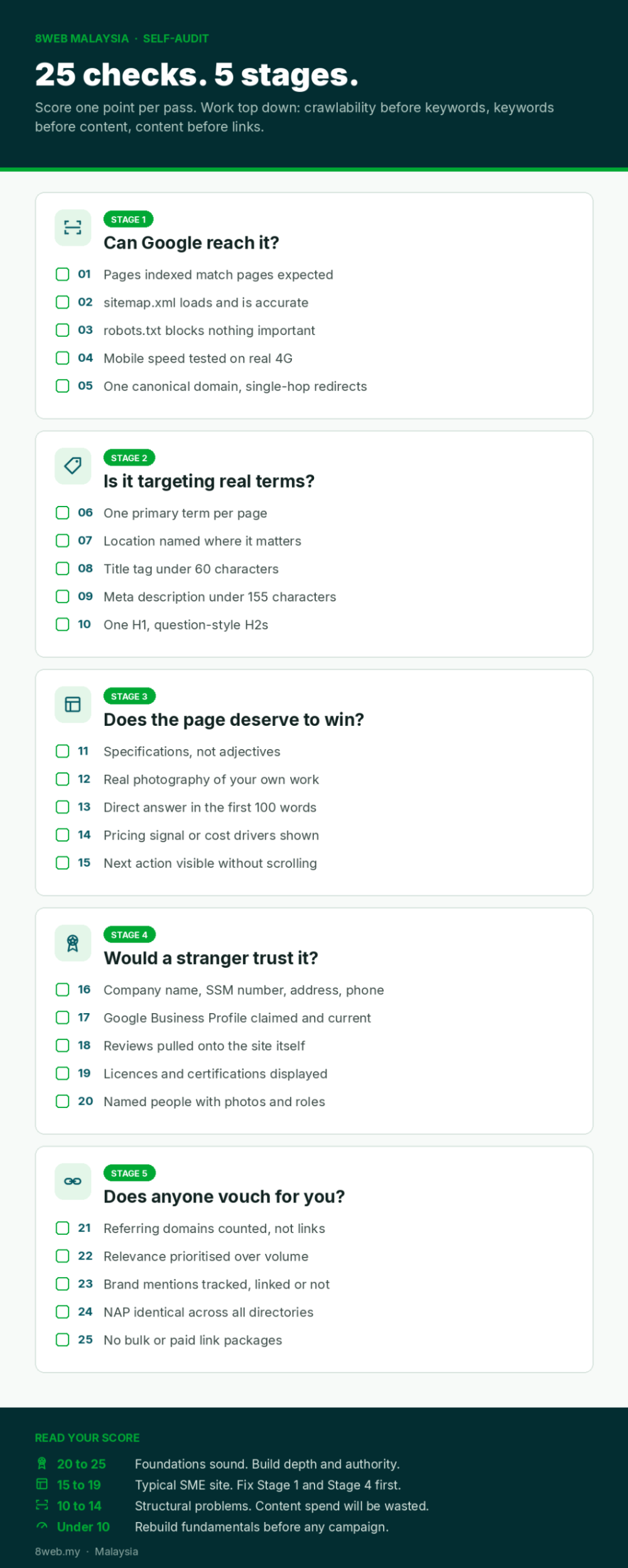
Stage 1: Can Google reach and read your site? (5 checks)
If a page cannot be crawled or rendered, nothing else on this list matters.
- Search site:yourdomain.com in Google. Does the count roughly match the number of pages you expect? Missing pages are the finding here.
- XML sitemap. Does yourdomain.com/sitemap.xml load, list your live pages, and exclude drafts, tags and thin archives?
- txt. Confirm it is not blocking anything you want indexed. Staging rules left in place after launch are one of the most common causes of a site disappearing.
- Mobile load speed. Run your top three revenue pages through PageSpeed Insights on mobile. Test on a real 4G connection, not office fibre.
- HTTPS and redirects. One canonical version of the domain. Every other variant should redirect to it in a single hop.
Google Search Console is free and will tell you most of this without guesswork. If nobody in your business has ever opened it, start there before spending on anything else.
Stage 2: Is every page targeting a real search term? (5 checks)
- One primary term per page. Each page should own one commercial term. Two pages chasing the same phrase compete with each other and both lose.
- Local qualifier where it matters. If you serve Klang Valley, Penang or Johor specifically, say so in the copy. “SEO company Malaysia” and “SEO company KL” are different searches with different intent.
- Title tag. Under roughly 60 characters, primary term near the front, no keyword stuffing.
- Meta description. Under roughly 155 characters, written as an advert rather than a summary.
- Heading structure. One H1 per page. H2s that pose the questions your buyer is actually asking, phrased the way they would type them.
That last point matters more every quarter. AI assistants and Google’s own summaries lift answers out of pages where the question is asked plainly and answered immediately underneath.
Stage 3: Does the page deserve to win? (5 checks)
- Genuine detail. Specifications, materials, dimensions, coverage area, scope of works. Not adjectives.
- Real images. Your own product, premises or team. Stock photography of a generic office signals nothing and is often a negative trust cue.
- Answer near the top. State the direct answer within the first 100 words, then expand. This is what gets quoted.
- Pricing signals. A range, a starting price, or an honest explanation of what drives cost. Total silence on price is a common reason enquiries never arrive.
- A clear next action. Enquiry form, WhatsApp button or quotation request, visible without scrolling to the footer.
Stage 4: Would a stranger trust this business? (5 checks)
This is the stage most Malaysian SME sites fail, and it is the cheapest to fix.
- Real business identity. Company name, registration number, physical address and a Malaysian phone number, consistent everywhere.
- Google Business Profile. Claimed, verified, categorised correctly, with current opening hours and photos.
- Reviews visible on site. Not just on the profile. Pull them onto the pages where the decision is made.
- Credentials shown. Licences, certifications, partner or reseller status, association membership.
- Named humans. Who does the work. A photo and a role beats an anonymous “our team of experts”.
The trust stage has measurable weight. BrightLocal’s Local Consumer Review Survey 2025 found that 74 percent of consumers check two or more review sites before choosing a local business, and only 4 percent never read reviews at all. Note that the survey polled 1,026 US adults, so read it as a directional signal for consumer behaviour rather than a Malaysian sample. The behaviour it describes, cross-checking a business across several sources before committing, will be familiar to anyone who has bought anything locally.
If your Google profile shows 4.8 stars and your Facebook page has three unanswered complaints from 2023, buyers notice the gap.
Stage 5: Does anyone else vouch for you? (5 checks)
- Referring domains. Check how many separate websites link to you. One link from fifty different sites beats fifty links from one.
- Relevance over volume. Links from Malaysian business directories, trade associations and suppliers in your sector are worth more than bulk placements.
- Brand mentions without links. Being named in an article still builds the association, particularly for AI-driven search.
- Consistent NAP. Name, address and phone identical across every directory listing. Inconsistency actively suppresses local visibility.
- Nothing bought in bulk. Cheap link packages are the fastest route to a manual penalty. If a vendor quotes a fixed price per link with a guaranteed count, walk.
How to read your score
| 20 to 25 | Foundations are sound. Focus on content depth and earning authority. |
| 15 to 19 | Typical for an SME site. Fix Stage 1 and Stage 4 first for the fastest return. |
| 10 to 14 | Structural problems. Content investment will be wasted until these are resolved. |
| Under 10 | Rebuild the fundamentals before spending anything on campaigns. |
Work top down. Crawlability before keywords, keywords before content, content before links. Skipping ahead is how businesses end up paying for backlinks that point at a page Google cannot even render.
“Nine out of ten audits we run in Malaysia turn up the same three issues: a slow mobile homepage, service pages that never name a location, and no proof of the business anywhere above the fold. None of those need a developer. They need someone to decide the site should be honest about who it serves.” 8Web Malaysia
Frequently asked questions
How often should I run this SEO checklist?
Once a quarter for a stable site, and immediately after any redesign, migration or CMS change. Most sudden traffic drops in Malaysia trace back to a launch that quietly reintroduced a blocking rule.
Do I need paid tools to complete this audit?
No. Google Search Console and PageSpeed Insights cover most of Stage 1 to Stage 3 at no cost. Paid tools such as Ahrefs or Semrush help mainly with Stage 5, where you need referring domain data.
Which stage gives the fastest results?
Stage 1 and Stage 4. Speed fixes and trust signals both tend to move enquiry volume within weeks, well before ranking changes appear.
Is local SEO different from regular SEO in Malaysia?
The fundamentals are identical. Local SEO adds Google Business Profile management, location-specific pages and citation consistency across Malaysian directories. If you serve customers in a defined area, treat it as essential rather than optional.
Should I optimise for AI assistants as well as Google?
Yes, and the work overlaps heavily. Clear question-based headings, direct answers stated early, cited sources and identifiable authors help you in both classic search results and AI-generated answers.
| Author:
Written by the 8Web Malaysia team. 8Web Malaysia is part of the 8clicks group, delivering SEO, web development and paid media for businesses across Malaysia. Last updated: 7 September 2026 Sources cited: DataReportal, Digital 2026: Malaysia. BrightLocal, Local Consumer Review Survey 2025 (panel of 1,026 US adult consumers). |